8 Reasons El Nido, Palawan Belongs on Every Water Lover’s Travel List
Most waterfall enthusiasts think in vertical terms. The drop. The height. The volume of water leaving the lip and hitting the pool below. Angel Falls in Venezuela at 979 metres, Kaieteur in Guyana pushing thousands of cubic metres per second over its sandstone edge, Victoria spanning nearly two kilometres of the Zambezi. These are the landmarks that define the world of falling water, and they deserve every bit of attention they get.
But water moves in more ways than straight down, and some of the most striking natural water environments on earth are defined less by a single dramatic drop than by the full range of what water does when it has limestone, jungle, and the South China Sea to work with. El Nido, on the northern tip of Palawan island in the Philippines, is that kind of place. Hidden lagoons, freshwater streams cutting through karst to the coast, waterfalls spilling directly into the sea, and underwater visibility that makes snorkelling feel like floating through glass. For anyone who travels for water, El Nido makes a strong case.
Here are eight reasons it belongs on the list.
1. The Karst Limestone Formations Are What Water Does Over Millions of Years
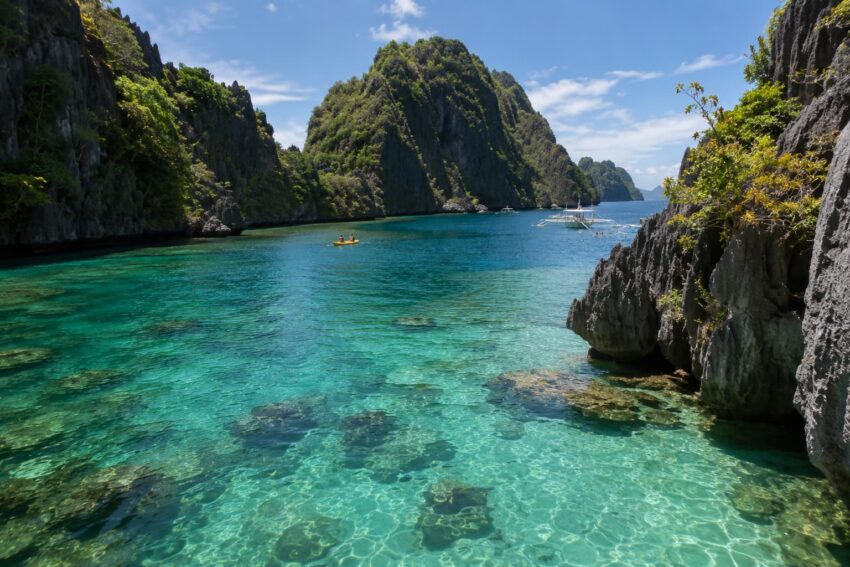
The Bacuit Archipelago surrounding El Nido contains over 45 islands, most of them limestone karst formations shaped by millions of years of rainfall, wave action, and chemical dissolution. The result is a landscape of sheer cliffs rising directly from the sea, undercut at the waterline by wave erosion, riddled with caves, and topped by jungle growing from cracks in the rock where soil has barely had time to accumulate.
For anyone interested in the relationship between water and geology, this landscape is a working demonstration. The same dissolution process that creates limestone caves and underground river systems has here been applied by seawater from below and rainfall from above simultaneously, producing formations that look like they were designed to be dramatic but are in fact just the logical outcome of chemistry and time. Walking the beaches between these karst towers gives you the same sense of geological scale that standing beside a great waterfall does, just expressed horizontally rather than vertically.
2. The Hidden Lagoons Are Unlike Any Other Water Body on Earth
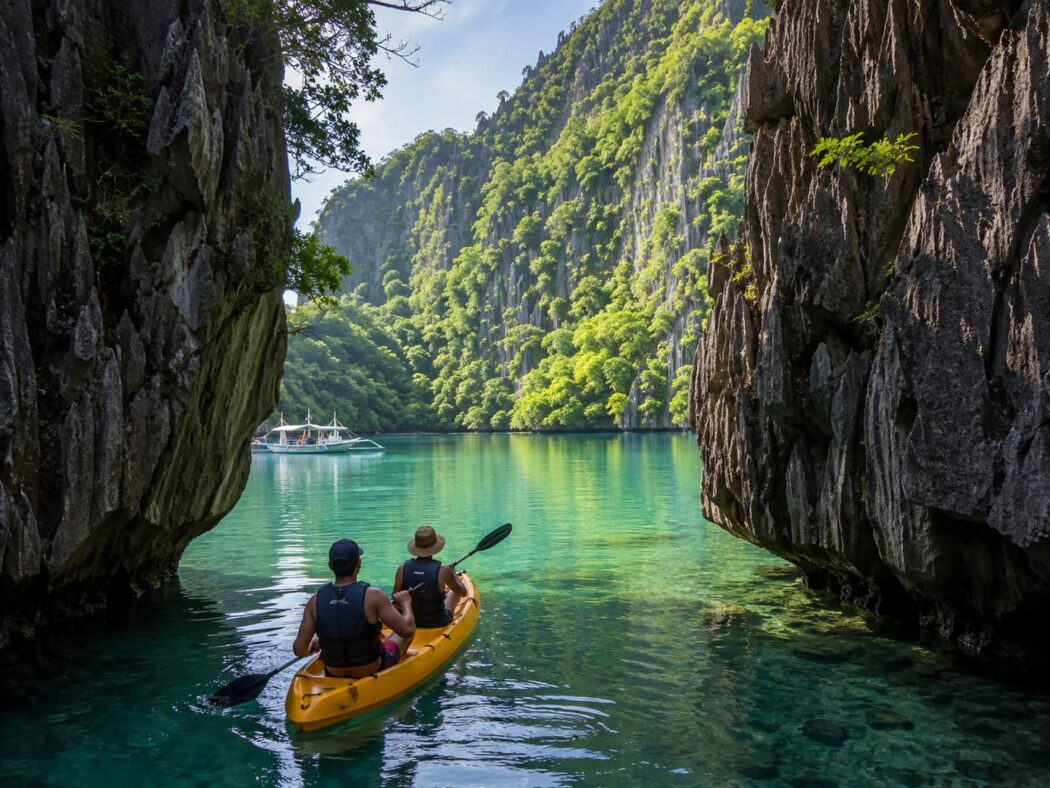
Inside several of the larger karst islands, enclosed by cliffs on all sides, are lagoons accessible only through narrow sea-level openings in the rock. The Big Lagoon and Small Lagoon on Miniloc Island are the most visited, but the principle repeats across the archipelago. You enter through a gap sometimes barely wide enough for a kayak, and the landscape opens into a completely enclosed body of water with vertical limestone walls rising 50 or 60 metres around you and a circle of sky above.
The water inside these lagoons is a colour that has no name in standard colour references: somewhere between jade and turquoise, lit from below by the pale sand bottom and filtered through the surrounding rock. It sits completely still while the sea outside is moving. The contrast between the open ocean and the interior silence of a hidden lagoon is one of those experiences that stays in the memory with unusual clarity. It is, in its own way, as arresting as looking up at a high waterfall from the pool below.
3. Freshwater Streams and Small Falls Feed Directly Into the Sea
Palawan’s interior is densely forested and receives heavy rainfall across much of the year. That rainfall moves through the limestone terrain, picks up minerals, and eventually finds its way to the coast through springs, seeps, and small waterfalls that emerge directly at the shoreline or just above it. In several spots around El Nido, freshwater waterfalls drop onto beaches or into the sea itself, creating the unusual visual of falling fresh water meeting salt water at the base.
These are not the towering cascades that make the lists of the highest waterfalls in the world, but they have their own character: intimate, surrounded by jungle, often accessible only by boat or a short wade through warm sea water. Finding them is part of the experience. A boat trip along the coast east of El Nido town will reveal several that don’t appear on any map.
4. The Underground River at Nearby Puerto Princesa Is One of the World’s Great Water Features
About four hours south of El Nido by road, the Puerto Princesa Subterranean River winds through an 8.2-kilometre cave system before emptying directly into the South China Sea. It’s one of the longest navigable underground rivers on earth and a UNESCO World Heritage Site. The river passes through multiple chambers with formations that took hundreds of thousands of years to build: stalactites, stalagmites, cave pearls, and curtain formations that the light from a boat torch barely reaches across.
The experience of travelling by small paddle boat through a darkened limestone cave while an underground river moves beneath you is completely unlike surface waterfall tourism. The sound is different: echoing, contained, the water moving in the dark beside you. The scale of the cave chambers, some large enough to hold a cathedral, is the kind of thing that recalibrates your sense of what water is capable of when given enough time and soluble rock to work with.
5. The Snorkelling and Diving Bring Water in a Third Dimension
The coral reef systems around El Nido are among the healthiest in the Philippines, partly because Palawan remains one of the less industrially developed provinces in the country and partly because the Bacuit Bay has been a designated protected area since the 1990s. The visibility in calm conditions can exceed 20 metres, which means that hovering above a reef wall in 10 metres of water and looking down into another 30 metres of clear blue is a regular occurrence rather than an exceptional one.
For waterfall enthusiasts, the underwater dimension of El Nido offers something structurally similar to what a great falls gives at the surface: the sensation of being beside or inside something that moves on a scale much larger than you are. Drifting along a wall reef that drops 40 metres into blue water below produces a version of the vertigo and awe that the edge of a great cascade does, just in a different medium and orientation.
6. Tour Routes Are Organised Around the Water, Not the Land
El Nido’s island-hopping tours are categorised into four official routes, known simply as Tour A, B, C, and D. Each covers a different cluster of islands and features a different combination of lagoons, snorkelling spots, beaches, and caves. The tours are boat-based by necessity: most of the best sites are only reachable by sea, and the boat journey between them is itself part of the experience, moving through the karst formations at water level in a way that no elevated viewpoint replicates.
Operators like El Nido Tours offer structured experiences across these routes, with guides who know which lagoon entrances are passable at which tide, which snorkelling sites are clear on which wind direction, and which spots are worth an extended stop versus a quick look. For water-focused travelers who want to cover the full range of what the archipelago offers, having that local knowledge behind the itinerary makes a measurable difference to what you actually see.
7. The Sunset Over the Karst Islands Turns the Water Every Colour at Once
Angel Falls is named for Jimmie Angel, the American pilot who crash-landed near the falls in 1937 and brought international attention to what the indigenous Pemon people had always known was there. The falls themselves are best seen from the air or from the base, and the light at dawn and dusk transforms the water into something that looks less like a natural feature and more like a special effect. El Nido’s sunsets work on the same principle at a completely different scale.
When the sun drops behind the karst islands to the west of Bacuit Bay, it turns the water between the formations into a sequence of colour that shifts by the minute: gold, orange, deep red, and then the blue-grey of dusk settling over everything. The limestone cliffs hold the colour longer than the water does. If you’ve spent a day moving through lagoons and reef systems and beaches, this is the closing sequence. Great waterfall destinations tend to reward the traveler who stays for the changing light. Angel Falls is famous for this. El Nido gives you the same reward, spread across an entire bay.
8. The Wet Season Transforms the Whole Water System
El Nido’s dry season runs roughly from November through April, when the sea is calm, the visibility is at its best, and the island-hopping conditions are most reliable. This is when most visitors come, and for good reason. But the wet season, running from June through October, does something to the landscape that dry-season visitors never see.
The freshwater streams that trickle onto beaches in dry weather become proper cascades. The jungle on the karst islands goes a shade of green that has no dry-season equivalent. The waterfalls that emerge at the shoreline run with enough volume to swim under. The lagoon colours shift as freshwater input from rainfall changes the salinity and light behaviour of the enclosed water. The sea is rougher and some tours don’t run, but the El Nido that a wet-season visitor sees is a different place from the dry-season version, and for anyone interested in water systems in their most active state, it’s worth knowing the season shapes everything.
A Final Thought
Water in motion is the subject of this site, and rightly so. A great waterfall is one of the most concentrated expressions of natural force available to a traveler: height, volume, sound, mist, the long geological story of how a river found its way to an edge. That’s worth chasing around the world.
El Nido expands the vocabulary. It shows what water does when it has limestone to dissolve, cliffs to undercut, caves to fill, coral to build, and a tropical sky to reflect. The lagoons and the underground rivers and the reef walls and the freshwater falls dropping onto beach sand are all part of the same story: water finding its way through the landscape over more time than we have good intuitions for.
It belongs on the list. Go in the dry season for the conditions, or the wet season for the spectacle. Either way, bring more time than you think you need.